Everything You Need to Know Before Ordering Custom Souvenir Magnets from China
Introduction
If you have ever sourced souvenirs for a museum gift shop, tourist attraction, aquarium, national park, cruise port, or souvenir distribution business, you already know that fridge magnets are among the most consistently profitable souvenir products in the world.
They are affordable, lightweight, easy to display, and purchased by travelers of all ages. Unlike apparel or seasonal merchandise, souvenir magnets rarely face sizing issues, fashion trends, or inventory complications.
However, many first-time buyers underestimate how much planning goes into creating a successful custom fridge magnet program.
Over the past twenty years, we have seen souvenir buyers make the same costly mistakes repeatedly:
- Choosing suppliers based solely on the lowest quotation.
- Selecting materials that do not match their target market.
- Ordering quantities that are too small.
- Ignoring packaging requirements.
- Underestimating shipping costs.
- Focusing on production cost instead of retail profitability.
The result is often disappointing sales performance, excessive inventory, or products that fail to reflect the destination’s identity.
This guide was created to help souvenir importers, wholesalers, distributors, and gift shop buyers understand how custom fridge magnets are actually developed, manufactured, priced, and shipped.
By the end of this guide, you will understand:
- Which magnet materials are best for your market.
- How custom magnet pricing really works.
- What MOQ requirements you should expect.
- How to evaluate a reliable manufacturer.
- Common mistakes that increase project costs.
- How successful souvenir retailers approach product development.
If you are currently looking for a production partner, you can also explore our Custom Fridge Magnet Manufacturer page for additional manufacturing information.
Chapter 1: Why Fridge Magnets Continue to Dominate the Souvenir Industry

Every year, new souvenir products enter the market.
Travel tumblers.
Reusable bags.
Phone accessories.
Fashion items.
Digital collectibles.
Yet fridge magnets continue to remain one of the top-selling souvenir categories globally.
Why?
The answer comes down to customer psychology.
Magnets Create Daily Visibility
Most souvenirs are stored in drawers, boxes, or closets.
A fridge magnet is different.
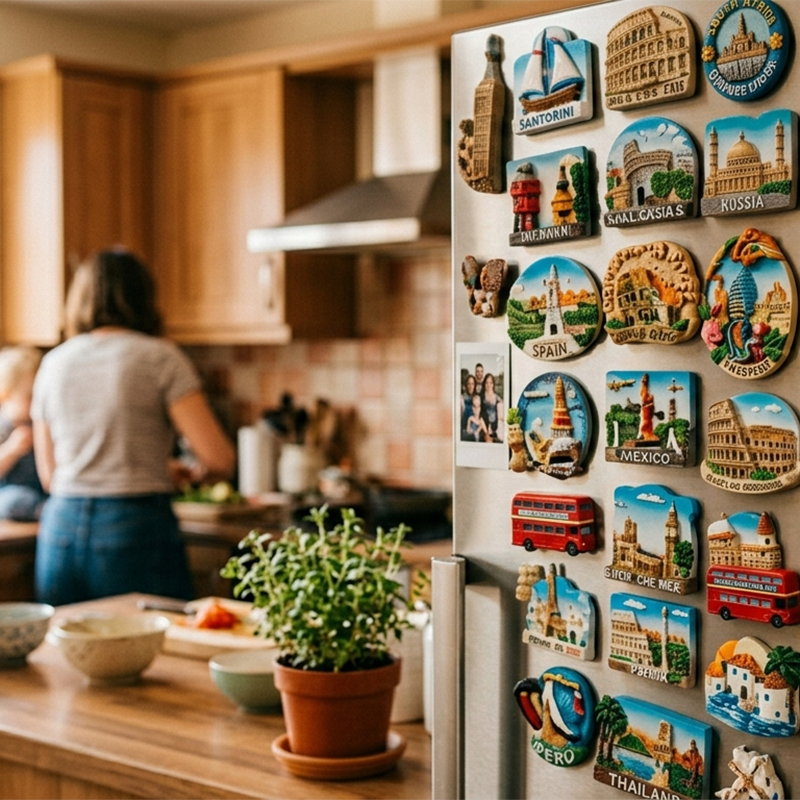
Customers see it every day.
Every time they walk into their kitchen, they are reminded of:
- A family vacation.
- A national park visit.
- A cruise experience.
- A museum trip.
- A memorable destination.
This emotional connection makes magnets one of the highest-value souvenirs relative to their retail price.
Magnets Have Universal Appeal
A souvenir T-shirt may not fit every customer.
A decorative statue may require significant shelf space.
A fridge magnet works for nearly everyone.
Whether the customer is:
- A child.
- A retiree.
- An international tourist.
- A cruise passenger.
- A collector.
The product remains accessible and affordable.
This universal appeal is one reason many gift shops report consistent magnet sales regardless of economic conditions.
Low Retail Risk for Gift Shops
From a retailer’s perspective, magnets offer several advantages:
- Small footprint.
- Easy merchandising.
- Low breakage rate.
- Strong impulse purchase behavior.
- Attractive profit margins.
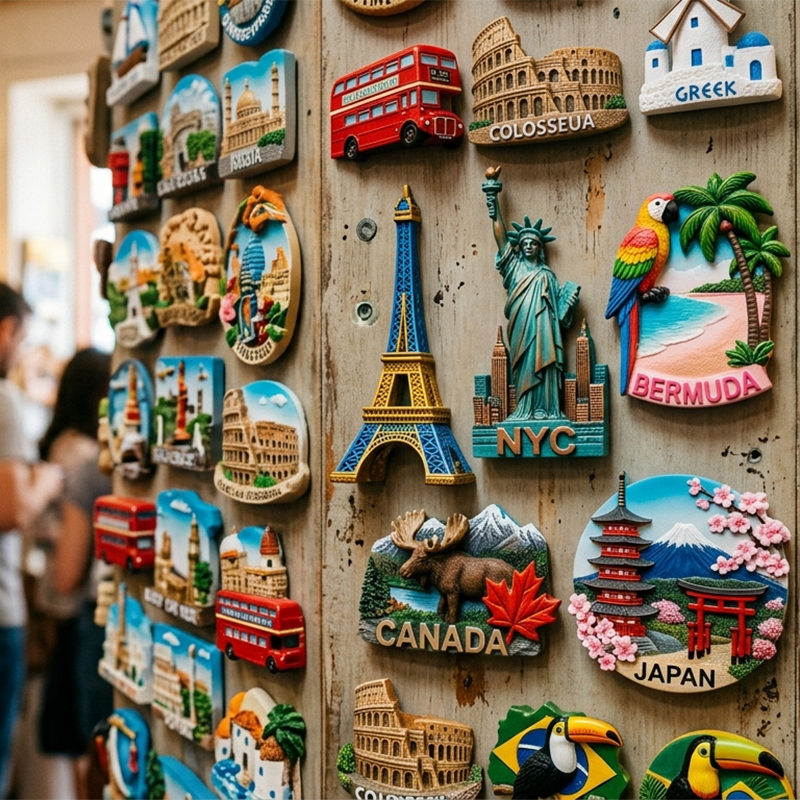
Many destination gift shops allocate entire display walls to magnet collections because they generate repeat purchases from collectors.
A visitor may buy one magnet during their first visit and return specifically to collect additional designs in the future.
Chapter 2: Understanding the Different Types of Custom Fridge Magnets
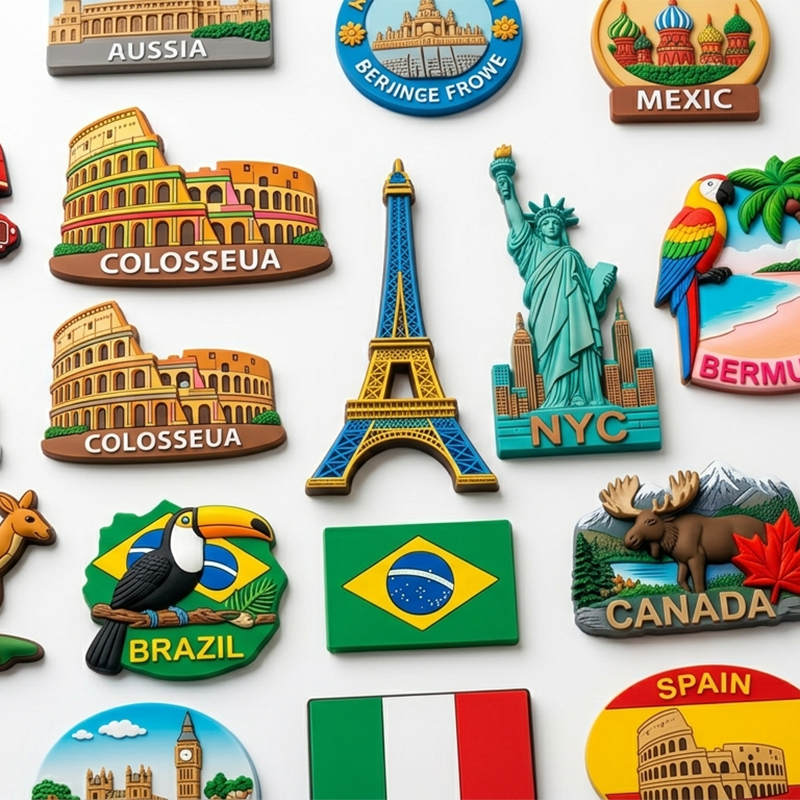
One of the biggest mistakes buyers make is assuming all fridge magnets are essentially the same.
In reality, material selection significantly impacts:
- Production cost.
- Retail price.
- Durability.
- Perceived value.
- Customer demographics.
Let’s examine the most common options.
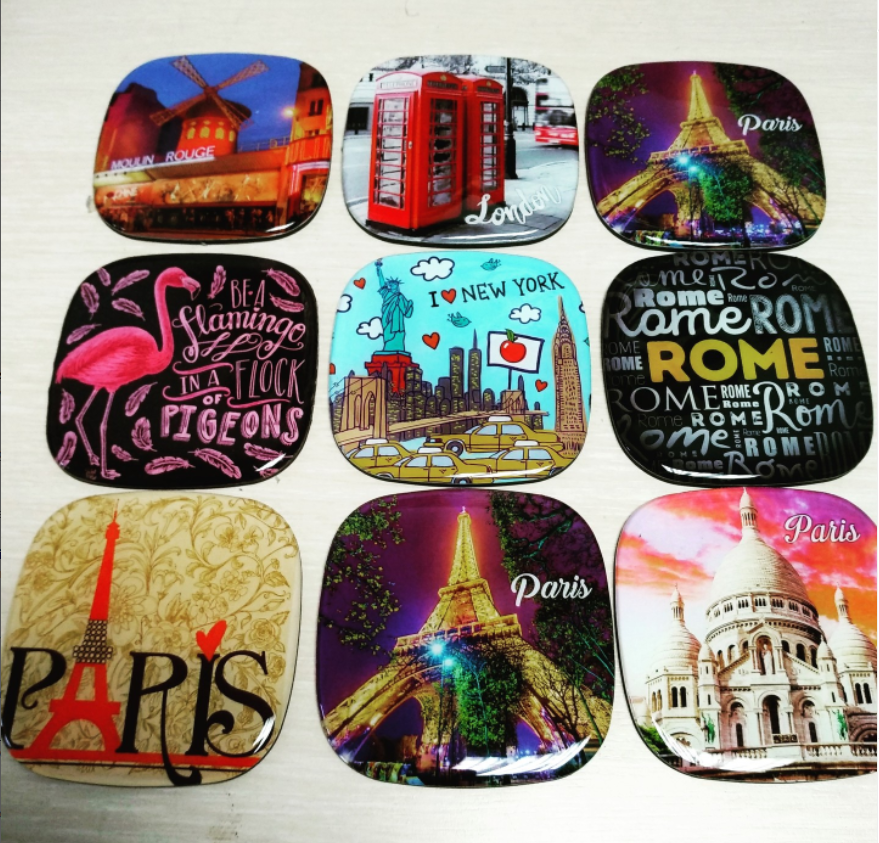
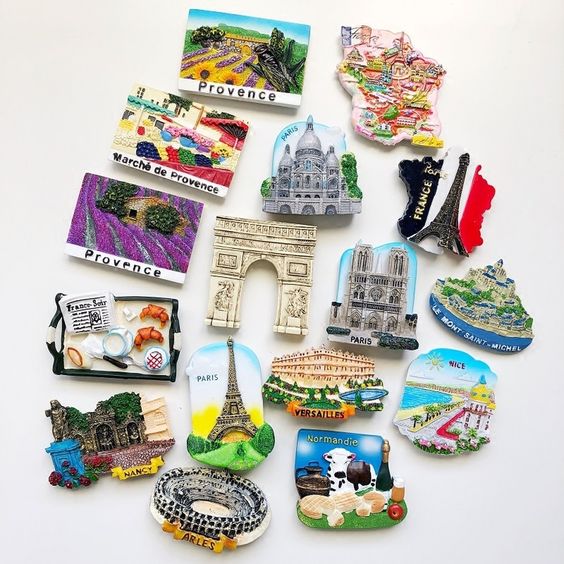
Resin Fridge Magnets
Resin remains the dominant material for premium tourism souvenirs.
Unlike flat printed magnets, resin allows highly detailed three-dimensional designs that replicate landmarks, buildings, animals, vehicles, and local cultural icons.
Advantages
- Strong visual impact.
- Excellent 3D sculpting capabilities.
- Premium souvenir appearance.
- High perceived value.
- Suitable for hand-painted finishes.
Typical Applications
- City landmarks.
- National parks.
- Cruise destinations.
- Historical attractions.
- Museums.
- Zoos.
- Aquariums.
For destinations seeking collectible products that command higher retail prices, resin magnets are often the preferred solution.
Potential Limitations
Resin products generally require:
- Mold development.
- Hand painting.
- Longer production times.
As a result, pricing is usually higher than PVC alternatives.
However, many buyers discover that increased retail pricing more than compensates for the higher manufacturing cost.
PVC Fridge Magnets
PVC magnets are widely used in promotional and high-volume souvenir programs.
They offer flexibility and lower production costs.
Advantages
- Cost-effective.
- Lightweight.
- Colorful.
- Suitable for large-volume orders.
Best For
- Promotional campaigns.
- Visitor centers.
- Budget souvenir programs.
- Event merchandise.
PVC is often selected when pricing is the primary concern.
However, buyers should understand that lower manufacturing cost can sometimes result in lower perceived retail value.
Metal Fridge Magnets
Metal magnets offer a more premium and collectible appearance.
These are frequently used by:
- Museums.
- Heritage sites.
- Historical landmarks.
- Commemorative events.
The perceived value is typically strong among adult collectors.
However, metal magnets may not offer the same colorful visual appeal as resin products.
Acrylic Fridge Magnets
Acrylic magnets are popular for photography-based souvenir programs.
Advantages include:
- Sharp image reproduction.
- Fast production.
- Modern appearance.
Many destinations use acrylic magnets for photographic designs rather than sculpted artwork.
Chapter 3: Why Most First-Time Buyers Choose the Wrong Material
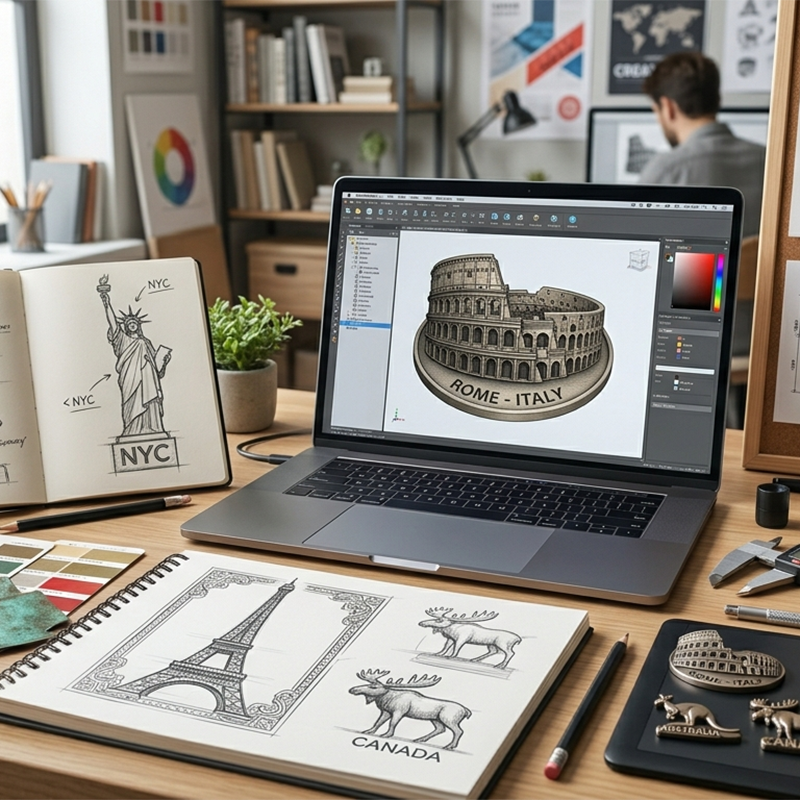
One of the most common conversations we have with new customers begins with a simple request:
“We want the cheapest option.”
This approach often creates problems later.
The reality is that manufacturing cost and retail profitability are not the same thing.
Consider two hypothetical products:
Product A:
- Lower manufacturing cost.
- Lower retail price.
- Lower perceived value.
Product B:
- Higher manufacturing cost.
- Higher retail price.
- Higher perceived value.
- Better customer engagement.
Many experienced souvenir retailers focus on margin dollars rather than percentage savings.
The question should not be:
“Which product is cheapest to manufacture?”
The better question is:
“Which product generates the highest retail return per display space?”
This distinction separates successful souvenir programs from struggling ones.
Chapter 4: How Custom Fridge Magnet Manufacturing Actually Works

Many souvenir buyers have a general idea of what they want their magnet to look like, but very few understand what happens between the initial design concept and the finished product arriving on store shelves.
Understanding the manufacturing process helps buyers make better decisions, avoid costly mistakes, and communicate more effectively with suppliers.
Let’s walk through the complete production process.
Step 1: Concept Development
Every successful souvenir magnet starts with a story.
The strongest-selling souvenir products are rarely random designs.
Instead, they are built around:
- Local landmarks
- Cultural symbols
- Historical attractions
- Wildlife
- Famous architecture
- Tourism experiences
For example, a destination like Bermuda might incorporate:
- Colorful island houses
- Tropical fish
- Cruise ships
- Historic forts
- Lighthouses
The objective is not simply to create a magnet.
The objective is to create a miniature memory.
Step 2: Artwork Creation
Once the concept is finalized, artwork development begins.
Depending on the product type, this may include:
- 2D illustrations
- Layered artwork
- 3D sculpting references
- Color specifications
A common mistake made by first-time buyers is attempting to include too many elements in a single magnet.
A crowded design often becomes difficult to manufacture and less visually attractive.
In many cases, simpler designs outperform more complicated ones at retail.
Step 3: Sculpting and Mold Development
For resin fridge magnets, sculpting is one of the most important stages.
Professional sculptors convert the artwork into a three-dimensional model.
This model determines:
- Product depth
- Texture
- Layering
- Visual impact
Once approved, a production mold is created.
The mold becomes the foundation for all future manufacturing.
This is why many experienced souvenir buyers treat mold development as a long-term investment rather than a one-time expense.
Step 4: Sample Production
Before mass production begins, samples are created.
This stage allows buyers to evaluate:
- Colors
- Details
- Dimensions
- Magnet strength
- Packaging compatibility
Many costly production problems can be avoided during sample approval.
Experienced buyers never rush this stage.
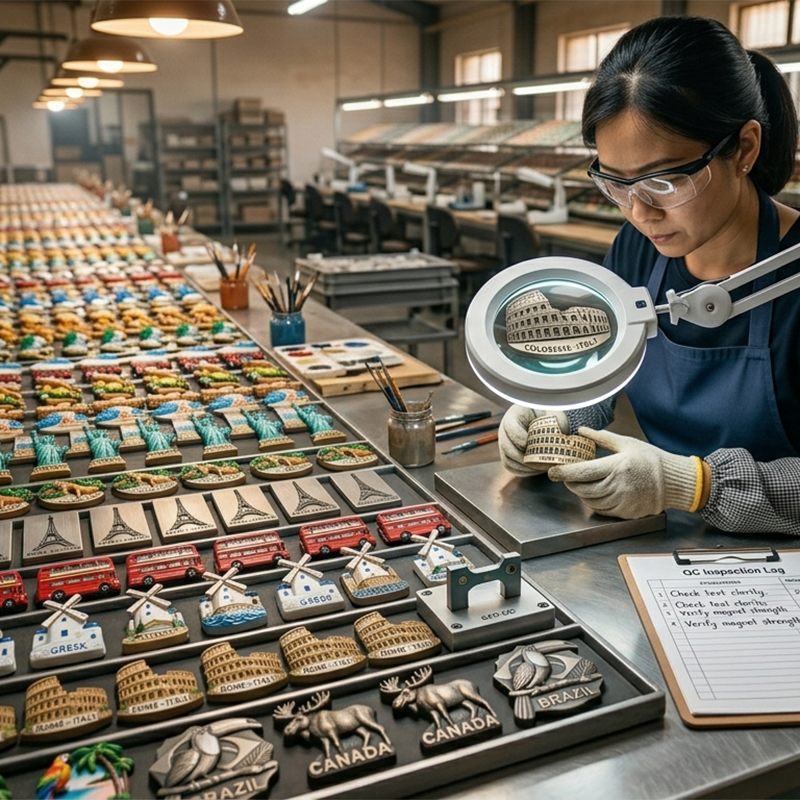
Step 5: Mass Production
After approval, production begins.
For resin magnets, this generally includes:
- Resin casting
- Trimming
- Surface preparation
- Hand painting
- Magnet attachment
- Quality inspection
Hand-painted products typically require significantly more labor than printed alternatives.
However, they often achieve stronger visual impact and higher retail value.
Step 6: Packaging and Export Preparation
The final stage involves:
- Individual packaging
- Carton packing
- Barcode labeling
- Shipping mark preparation
- Export documentation
At this point, the product is ready for international shipment.
Chapter 5: How Custom Fridge Magnet Pricing Really Works
One of the biggest misconceptions in the souvenir industry is that pricing is determined primarily by material cost.
In reality, material cost is only one component.
Many buyers focus on unit price while overlooking several other factors that significantly affect total project cost.
Let’s break down the real cost structure.
Mold Development Cost
For custom designs, mold creation is usually the first investment.
Factors affecting mold cost include:
- Product size
- Design complexity
- Number of layers
- Sculpting difficulty
- Separate components
A simple flat magnet requires less development work than a highly detailed 3D resin design.
However, many buyers recover mold costs quickly through repeat production runs.
Production Cost
Production costs include:
- Raw materials
- Labor
- Painting
- Assembly
- Quality control
In souvenir manufacturing, labor often represents a larger cost component than materials.
This is especially true for hand-painted resin products.
Packaging Cost
Packaging can dramatically influence final costs.
Common options include:
Polybag Packaging
Most economical.
Suitable for wholesalers.
Blister Card Packaging
Excellent retail presentation.
Popular in tourist gift shops.
Gift Box Packaging
Used for premium collections.
Often selected by museums and specialty retailers.
Shipping Cost
Shipping costs vary based on:
- Destination country
- Product weight
- Carton volume
- Shipping method
Many first-time buyers underestimate the impact of carton dimensions on freight costs.
Reducing packaging size by even a small percentage can significantly lower shipping expenses across large orders.
Chapter 6: MOQ Explained: Why Factories Have Minimum Order Quantities
One question every buyer asks is:
“Can I order a very small quantity?”
The answer depends on the manufacturing process.
Factories establish Minimum Order Quantities (MOQs) for practical reasons.
Tooling Costs
Every custom project requires setup work.
This includes:
- Artwork preparation
- Mold development
- Sample creation
- Production setup
These costs exist regardless of whether the order is 500 pieces or 50,000 pieces.
Labor Efficiency
Production lines are designed for efficiency.
Very small runs often require nearly the same setup effort as larger orders.
As a result, unit costs increase significantly when quantities are low.
Inventory Planning
Experienced buyers often view MOQ as a strategic inventory decision rather than a manufacturing limitation.
A larger order may improve:
- Unit cost
- Packaging efficiency
- Freight efficiency
- Profit margin
The goal is not simply meeting MOQ.
The goal is maximizing return on investment.
Chapter 7: Packaging Strategies That Increase Retail Sales
Many souvenir buyers spend months discussing product design and only minutes discussing packaging.
This is a mistake.
Packaging influences:
- First impressions
- Perceived value
- Giftability
- Retail display performance
The Psychology of Packaging
Consumers often evaluate products before touching them.
Packaging communicates:
- Quality
- Professionalism
- Brand value
A premium package can justify a higher retail price even when the product itself remains unchanged.
Retail Display Considerations
Gift shops frequently have limited display space.
Effective packaging should:
- Maximize visibility
- Protect products
- Improve organization
- Encourage impulse purchases
The best packaging is not always the most expensive packaging.
It is the packaging that supports the customer’s purchasing decision.
Chapter 8: How To Choose a Reliable Fridge Magnet Manufacturer
Selecting the right supplier may be more important than selecting the right product.
A strong supplier can help improve:
- Design quality
- Production efficiency
- Packaging solutions
- Delivery reliability
Evaluate Experience
Ask:
How long has the supplier served the souvenir industry?
A factory specializing in souvenirs typically understands:
- Tourist buying behavior
- Gift shop requirements
- Packaging expectations
- Retail trends
Better than a general promotional products manufacturer.
Review Existing Projects
Experienced suppliers should be able to provide:
- Product photographs
- Case studies
- Packaging examples
- Export experience
Past projects often reveal more than marketing claims.
Communication Matters
One of the strongest indicators of future project success is communication quality.
If communication is slow during sampling, it may become even slower during production.
Reliable communication reduces risk throughout the supply chain.
Chapter 9: Common Buying Mistakes That Cost Importers Thousands of Dollars
After working with souvenir buyers from around the world, several mistakes appear repeatedly.
Mistake #1: Buying Based Only on Price
The lowest quotation is rarely the lowest total cost.
Quality problems, delays, and poor packaging often create larger expenses later.
Mistake #2: Ignoring Packaging Requirements
Many buyers finalize packaging after production.
This often leads to avoidable redesign costs.
Mistake #3: Overcomplicated Designs
More details do not always equal better sales.
Clear, recognizable designs often outperform complicated artwork.
Mistake #4: Choosing the Wrong Material
A product that works well for a museum may not perform well in a beach resort gift shop.
Material selection should match customer expectations.
Chapter 10: What Successful Souvenir Retailers Do Differently
Successful souvenir retailers rarely focus on individual products.
Instead, they build collections.
Examples include:
- Landmark Series
- Wildlife Series
- Historical Series
- Seasonal Series
Collections encourage repeat purchases.
Collectors often buy multiple designs rather than a single item.
This strategy can significantly increase average transaction value.
Many of the highest-performing souvenir programs worldwide rely on this approach.
Final Thoughts
Custom fridge magnets remain one of the most reliable souvenir categories available to gift shops, distributors, museums, aquariums, tourism organizations, and wholesalers.
Success is rarely determined by finding the cheapest supplier.
Instead, it comes from understanding:
- Material selection
- Product design
- Manufacturing processes
- Packaging strategy
- Freight planning
- Retail positioning
The most successful buyers view custom fridge magnets not as simple promotional products, but as long-term retail assets that strengthen destination branding and generate repeat sales.
Whether you are launching your first souvenir collection or expanding an existing product line, taking the time to understand the complete buying process will help you make better purchasing decisions and achieve stronger retail performance.
Ready to start your project?
Explore our Custom Fridge Magnet Manufacturer page to learn more about custom design capabilities, manufacturing solutions, packaging options, and export services for souvenir businesses worldwide.

- Tourist Souvenir Design Guide: How to Create Best-Selling Souvenirs for Gift Shops, Tourist Attractions, and Destination Brands - June 24, 2026
- The Complete Custom Fridge Magnet Buying Guide for Souvenir Importers (2026) - June 17, 2026
- Tariff Navigation 2026: Sourcing from China vs. Vietnam for North American Brand Retailers - June 10, 2026