In the arena of global travel retail, procurement is often a tug-of-war between two powerful financial forces: the allure of the bulk discount and the stealthy, margin-eroding nature of inventory holding costs. For a Category Manager at a global powerhouse like Dufry, Hudson, or Lagardère, the decision to pull the trigger on a 100,000+ unit order of resin souvenirs isn’t just about getting a lower “per-unit” price. It is a complex exercise in capital allocation.
At Craftmgf.com, we see thousands of procurement spreadsheets every year. Most of them make the same mistake: they celebrate a $0.05 reduction in unit price while ignoring a $20,000 “hidden” bill in warehouse utility, insurance, and capital opportunity costs.
As we navigate the 2026 economic landscape, “buying big” is no longer a default strategy—it is a calculated risk. This guide will dissect the forensic math behind the Economic Order Quantity (EOQ) and show you how to find the “Sweet Spot” where your purchase price and your carrying costs reach a profitable equilibrium.
The Competitor Landscape: Why Surface-Level Sourcing Advice is a Financial Trap
Most B2B manufacturing content regarding “Bulk vs. Small Orders” is remarkably shallow. A typical competitor’s outline usually looks like this:
- Introduction: Buying more usually costs less per piece.
- The Pro: Bulk discounts save you money on the invoice.
- The Con: You need a place to put all those boxes.
- Conclusion: Find a balance that works for you.
The Skyscraper Expansion: The Engineering & Financial Edge
This standard approach fails to account for the molecular reality of materials and the time-value of money. Our “Ferris Wheel” expansion into the topic includes:
- The Opportunity Cost of Capital: What else could those funds be doing if they weren’t sitting in a pallet of magnets?
- Material Degradation over Time: The specific risks of storing resin (UV yellowing and brittleness) in non-climate-controlled environments.
- The “Obsolescence Curve”: Why a 100k order for a 2026 trend might become “Dead Stock” by 2027.
- Supply Chain Elasticity: How to use Vendor Managed Inventory (VMI) to get bulk pricing without the bulk storage.
1. The Psychology of the “Big Save”: Why Unit Price is a Distraction

In procurement meetings, the “FOB Unit Price” is the loudest number in the room. When a China souvenir factory offers a price break at 100,000 units, it looks like an instant win for the yearly KPI.
However, the unit price is merely the visible cost. The true cost of a souvenir is a living number that increases every day it sits on a warehouse shelf. For an experienced souvenir importer, the goal isn’t the lowest price—it’s the highest Net Present Value (NPV) of the inventory. If you save $5,000 on the purchase but spend $7,000 in interest and storage over 12 months, your “bulk discount” was actually a $2,000 penalty.
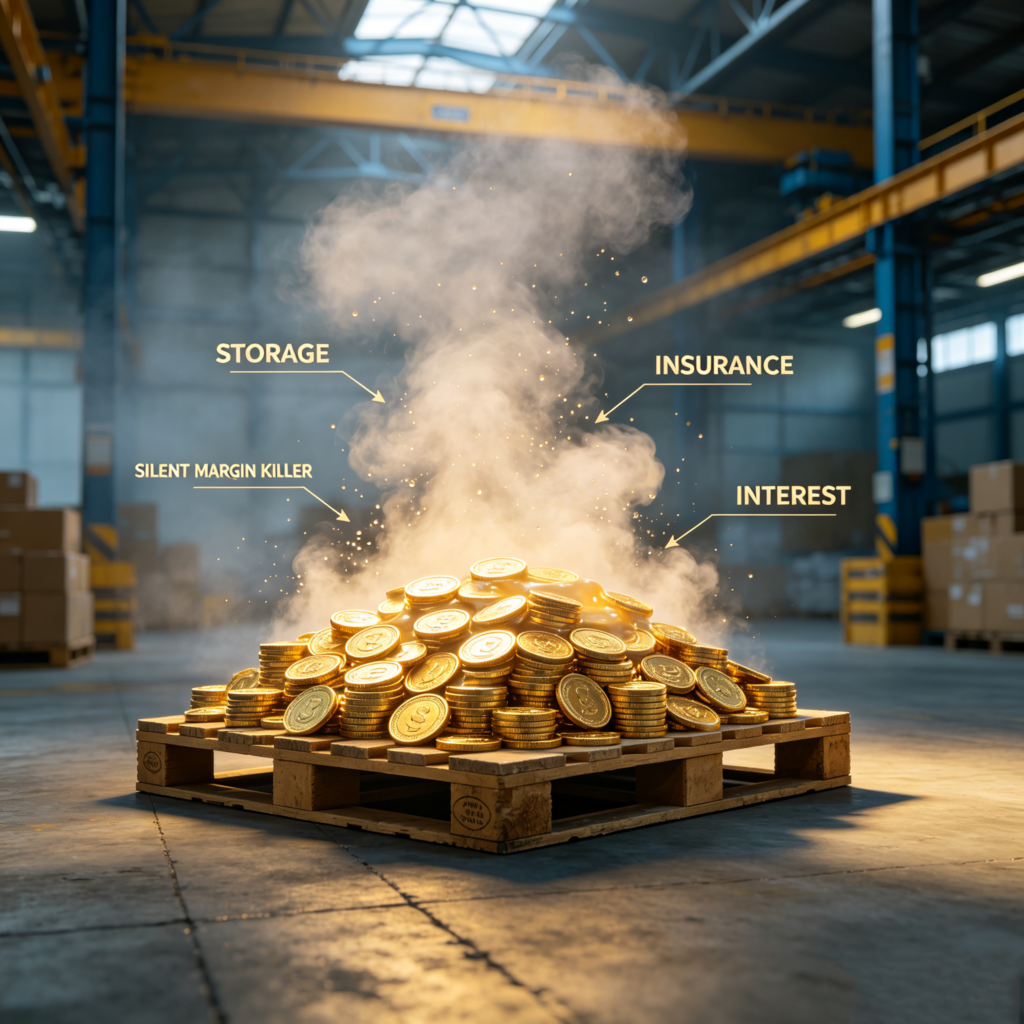
2. The Anatomy of Holding Costs: The Silent Margin Killers
Inventory holding costs (also known as carrying costs) typically range from 20% to 30% of the total inventory value annually. For a bulk order of 100,000 units, these costs break down into four “hard” categories:
A. Capital Costs (The Opportunity Cost)
This is the biggest hidden factor. If you spend $100,000 on inventory, that money is “locked.” If your company’s internal rate of return (IRR) is 10%, every year that inventory sits in a box, you are effectively “losing” $10,000 that could have been invested in new product development or marketing.
B. Storage Space Costs
Warehouse rent, lighting, security, and climate control. Resin products, while durable, are sensitive to extreme heat (which can cause warping) and high humidity (which can affect the bonding of hand-painted details).
C. Inventory Service Costs
Insurance premiums and taxes. The more inventory you have, the higher your insurance cost to cover fire, theft, or water damage.
D. Inventory Risk Costs (Obsolescence)
In the travel retail world, trends shift. A design that is “hot” in the 2026 summer season may see a 40% drop in demand by 2027. If you are sitting on 50,000 unsold units, you are forced to liquidize at a loss.
3. The Resin Factor: Why Material Science Dictates Order Size

Unlike metal or ceramic, resin (polyresin/epoxy) has specific storage nuances that an experienced souvenir importer must respect.
The Yellowing and Brittleness Risk
Even in high-quality resin formulations, long-term storage (18+ months) in non-optimal conditions can lead to molecular cleavage in the polymer chains. If your warehouse has UV-exposure or lacks temperature regulation, the white areas of your souvenirs may develop a yellow tint, and the intricate 3D details may become brittle.
When you calculate the “Sweet Spot” for a 100,000-unit order, you must factor in a Degradation Discount. If 2% of your stock becomes unsellable due to long-term storage issues, that cost must be added to your initial unit price.
4. Data Comparison: Scenario Analysis for 100,000 Units

Let’s look at the forensic math. We are comparing a 12-month supply of a custom resin figurine for a major airport retail group.
| Financial Metric | Scenario A: Quarterly Sourcing (25k units x 4) | Scenario B: Single Bulk Order (100k units) | The “Sweet Spot” Impact |
| Unit Price (FOB) | $1.15 | $1.05 | Bulk saves $10,000 in purchase price. |
| Shipping & Logistics | $12,000 (4 Shipments) | $8,000 (1 Full Container) | Bulk saves $4,000 in freight. |
| Warehouse/Holding Cost (Yearly) | $2,500 | $12,000 | Bulk costs $9,500 more to store. |
| Capital Cost (8% Interest) | $1,800 | $8,400 | Bulk “locks” $6,600 in capital. |
| Obsolescence Risk (Est. 2%) | $500 | $2,100 | Bulk has higher risk of “Dead Stock.” |
| Total Landed Cost (TLC) | $131,800 | $135,500 | The “Bulk Discount” is actually $3,700 more expensive. |
The Verdict of the Math
In this specific scenario, Scenario A—despite the higher unit price—is the more profitable choice. This is because the inventory holding costs and capital costs outweighed the $0.10 unit discount. This is the “Trap” that wholesale souvenir distribution managers often fall into when they only look at the first two lines of the table.
5. Calculating the Sweet Spot: The EOQ Formula for Souvenirs
To find the mathematically perfect order size, professional Category Managers use the Economic Order Quantity (EOQ) formula. This formula balances the cost of ordering (shipping, setup, admin) against the cost of holding.
The standard formula is:
$$EOQ = \sqrt{\frac{2DS}{H}}$$
Where:
- $D$ = Annual Demand (e.g., 100,000 units)
- $S$ = Setup/Ordering Cost (Fixed cost per shipment)
- $H$ = Holding Cost per unit per year
At Craftmgf.com, we help our clients calculate a “Resin-Adjusted EOQ” that includes a variable for material degradation and trend-obsolescence. This ensures the “Sweet Spot” isn’t just a theoretical number, but a reflection of the actual travel retail market.
6. Strategic: How to Get Bulk Pricing Without the Holding Cost

What if you need the $1.05 price point to stay competitive, but your warehouse is full? This is where a manufacturing partnership becomes a competitive weapon.
A. Vendor Managed Inventory (VMI)
We offer a VMI model for our enterprise partners. We produce the 100,000 units to secure the bulk material discount, but we store the goods in our Quanzhou manufacturing hub and ship them in quarterly “Just-In-Time” (JIT) increments. This shifts the storage burden and allows you to keep your domestic warehouse lean.
B. The “Blanket Order” Strategy
Commit to 100,000 units over 12 months with a fixed price contract, but only take delivery in 20,000-unit batches. This protects you against currency volatility and price hikes while keeping your capital liquid.
C. Hybrid Material Sourcing
We can pre-purchase the raw resin and pigments at a bulk rate (hedging the material cost) but delay the actual 3D casting and hand-painting until you confirm the demand. This reduces the risk of being stuck with finished goods that no longer fit the current design trend.
7. Conclusion: From “Buying Products” to “Managing Capital”

The “Sweet Spot” for a 100,000-unit order is rarely the largest possible order. It is the volume that minimizes the sum of your ordering costs and your holding costs while maximizing your supply chain resilience.
For the experienced souvenir importer, the 2026 mandate is clear: Stop chasing pennies on the unit price and start chasing dollars on the Total Landed Cost. Sourcing is a memories business; manufacturing is a data business.
Is your inventory strategy leaking profit? Contact Craftmgf.com today. Our procurement experts will help you run a full EOQ analysis on your 2026 catalog to ensure your bulk orders are working for you, not against you.

- Souvenir Magnet Program Planning: What Actually Sells for Museums, Parks & Tourism Boards - October 20, 2026
- Custom Fridge Magnet Sampling and Proofing: The B2B Guide to Approving a Sample (2026) - October 15, 2026
- Custom Mold Ownership & Design IP Protection for Souvenir Magnets: A B2B Buyer’s Guide (2026) - October 9, 2026