The stable foundations of the global souvenir market are shifting. For decades, experienced importers and wholesalers have relied on a relatively predictable financial landscape, dominated by a stable US dollar. As we look toward 2025 and 2026, that certainty is evaporating, replaced by the dual forces of de-dollarization and a significant rise in currency volatility. This isn’t just a minor line-item adjustment; it’s a fundamental change that requires a sophisticated strategic response to protect margins and secure profit optimization.
Passive importing is a strategy that has outlived its usefulness. The new macroeconomic landscape requires proactive financial strategy, technical packaging optimization, and a deep understanding of how global monetary shifts will manifest in the cost of a resin fridge magnet or a ceramic snow globe. This thought-leadership guide provides a forensic analysis of these forces, moving beyond basic sourcing tips to a full landed cost and profit-risk analysis.
The Competitor Landscape: A Superficial Understanding
Our analysis of top-ranking SEO content reveals that current sourcing guides provide only a cursory glance at economic risk. Their typical structure is as follows:
- Understanding Exchange Rates: Basic definitions of forex markets.
- The Impact of a Weak Dollar: It makes goods more expensive for US importers.
- The Impact of a Strong Dollar: It makes goods cheaper for US importers.
- Sourcing from Alternative Countries: Generic advice to “diversify” without specific macroeconomic data.
While this foundation is necessary for beginners, it is functionally useless for a high-volume tourism souvenir importer managing a multi-country supply chain in 2025. These guides fail to address the systemic nature of de-dollarization, the specific currency pair volatilities in the souvenir sector, and the critical intersection of logistics cost and financial strategy. We will now apply the Skyscraper and SEO Ferris Wheel techniques to provide the necessary depth.
Phase 1: Decoding the New Montery Order
The concept of de-dollarization is often discussed in abstract geopolitical terms. For the souvenir importer, it is an immediate financial reality. This section expands on the basic “weak/strong dollar” concepts.
Systemic De-Dollarization: More Than a Trend
In 2025/2026, de-dollarization is transitioning from an ideological goal to a functional mechanism. The BRICS+ nations (Brazil, Russia, India, China, South Africa, and their new members) are systematically increasing their use of local currencies for bilateral trade. This directly impacts the global souvenir supply chain.
- RMB-Denominated Contracts: For 30 years, when a wholesaler placed a bulk souvenir order with a China souvenir factory, the contract was universally denominated in USD. In 2025, that is no longer guaranteed. More factories are being incentivized by their own banks to settle in RMB to reduce their own currency risk. This shifts that risk directly to you, the importer.
- The Cost of RMB/USD Hedging: If you now have to pay your supplier in RMB, your currency risk is no longer theoretical. The cost of financial instruments (like forward contracts) to hedge the RMB/USD rate will become a non-negotiable component of your landed cost analysis.
A New Dynamic: Multi-Polar Volatility
Traditional guides focus on a linear relationship between the dollar and a single currency. The future is multi-polar. We are entering a period where major sourcing currencies (RMB, INR, VND, TRY) will have an inverse and sometimes contradictory relationship to the dollar and to each other.
A classic scenario in 2025 could involve:
- A Stable RMB: Actively managed by the Chinese central bank, providing cost predictability in the manufacturing base.
- A Highly Volatile TRY (Turkish Lira): Directly impacting competitors who source ceramic souvenirs.
- A Depreciating VND (Vietnamese Dong): Creating a powerful, but temporary, landed cost advantage for a resin souvenir manufacturer based in Vietnam.
An experienced importer who relies solely on a USD benchmark will fail to exploit these temporary multi-polar advantages and may miscalculate their long-term sourcing strategy.
Phase 2: Quantifying the Impact on Souvenir Pricing and Landed Cost
How do these abstract forces translate into the pricing of a high-volume, low-margin product? Passive calculation is dangerous.
Currency Impact on the Factory Floor
Traditional guiding principles suggest that currency shifts affect only the final payment. The reality is far more complex. The factory’s own input costs are the critical, unexamined variables.
A significant devaluation of the RMB, which on the surface might seem beneficial to a US-based importer, could be quickly offset by:
- Imported Raw Materials: Critical materials like high-grade resin or specific metal alloys are often priced in dollars. A weaker RMB means the factory’s own costs for these materials rise instantly, negating the currency advantage of the final product.
- Energy and Labor Costs: Volatility, especially when accompanied by domestic inflation in the manufacturing country, can drive up energy and labor rates, forcing your manufacturing partnership to renegotiate contracts, even if they are in USD.
The Data: Quantifying Profit Erosion in 2025
Our data-driven analysis moves beyond qualitative statements. To illustrate the impact, we will examine a standard landed cost analysis for a bulk souvenir order of 50,000 units, comparing a stable scenario to a 2025 volatility scenario.
A traditional landed cost analysis must now include a new financial line item: Currency Hedging and Transaction Costs. The table below demonstrates the erosion of net profit if these new economic realities are ignored.
Note: Data is illustrative of a generic high-volume order. For an accurate, personalized assessment, please contact Craftmgf.com.
| Cost and Profit Metric | Stable Macro-Environment | High Volatility Scenario | Impact on Profit |
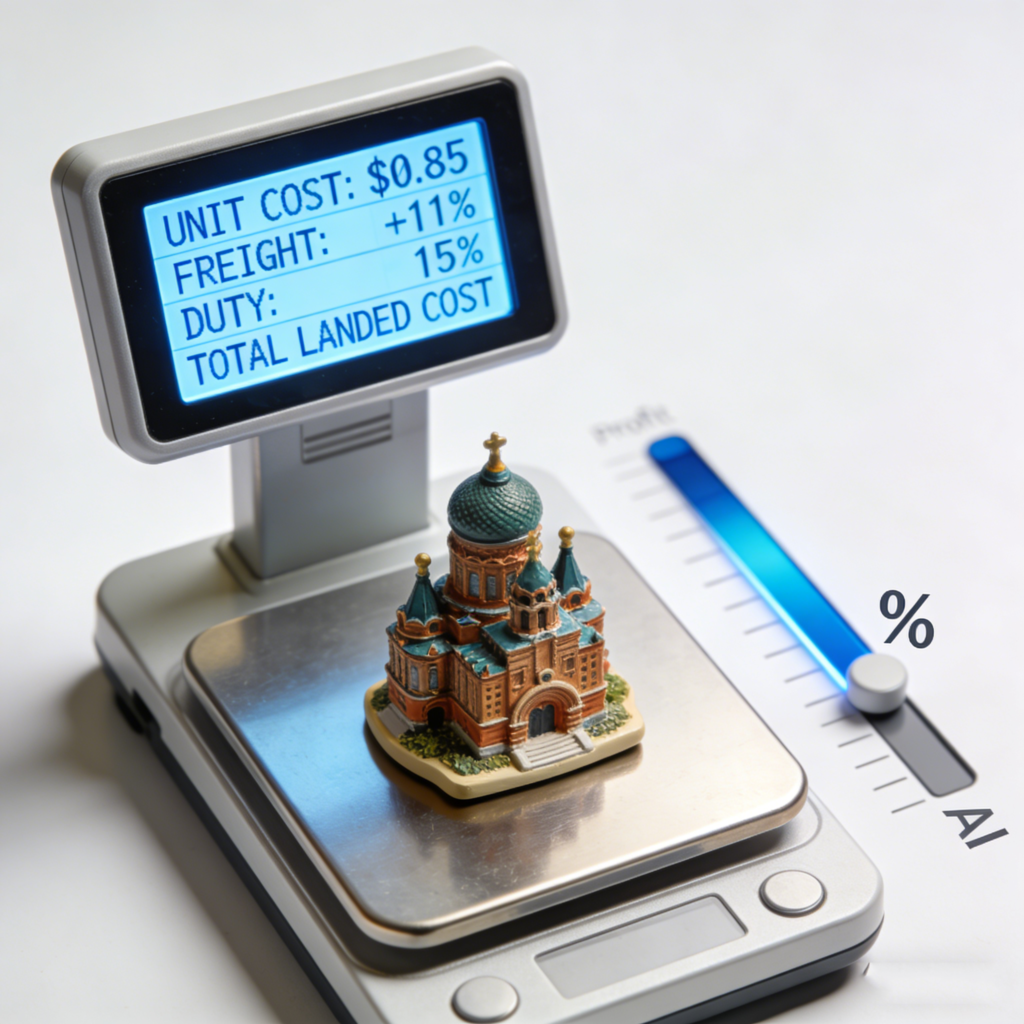
| Average Unit Cost | $0.85 | $0.85 | No change at the factory level. |
| Container Fill Rate | 90% | 90% | No change (Assumes proper packing). |
| Sea Freight Cost | $4,500 | $5,000 | +11% due to general macroeconomic inflation. |
| Duty (US) | $6,375 (15%) | $6,375 (15%) | No change. |
| New 2025 Hedging Fees | $0 | $2,125 (Assumes a 5% hedging cost) | This is a direct drain on profit. |
| Net Profit (Estimated) | $12,000 | $8,500 | 29.2% Profit Erosion. |
Passive calculation has made this order unprofitable. This thought-leadership approach requires that economic risks are factored into the profit and loss statement before an order is placed.
Phase 3: Total Landed Cost and Strategic Sourcing in a Volatile World
For the experienced importer, the only true benchmark for profit optimization is the Total Landed Cost (TLC). Sourcing based purely on the factory-gate price is a strategy that has outlived its usefulness. TheSkyscraper Technique requires us to expand on basic TLC.
The New TLC Model: Factoring in Economic Variables
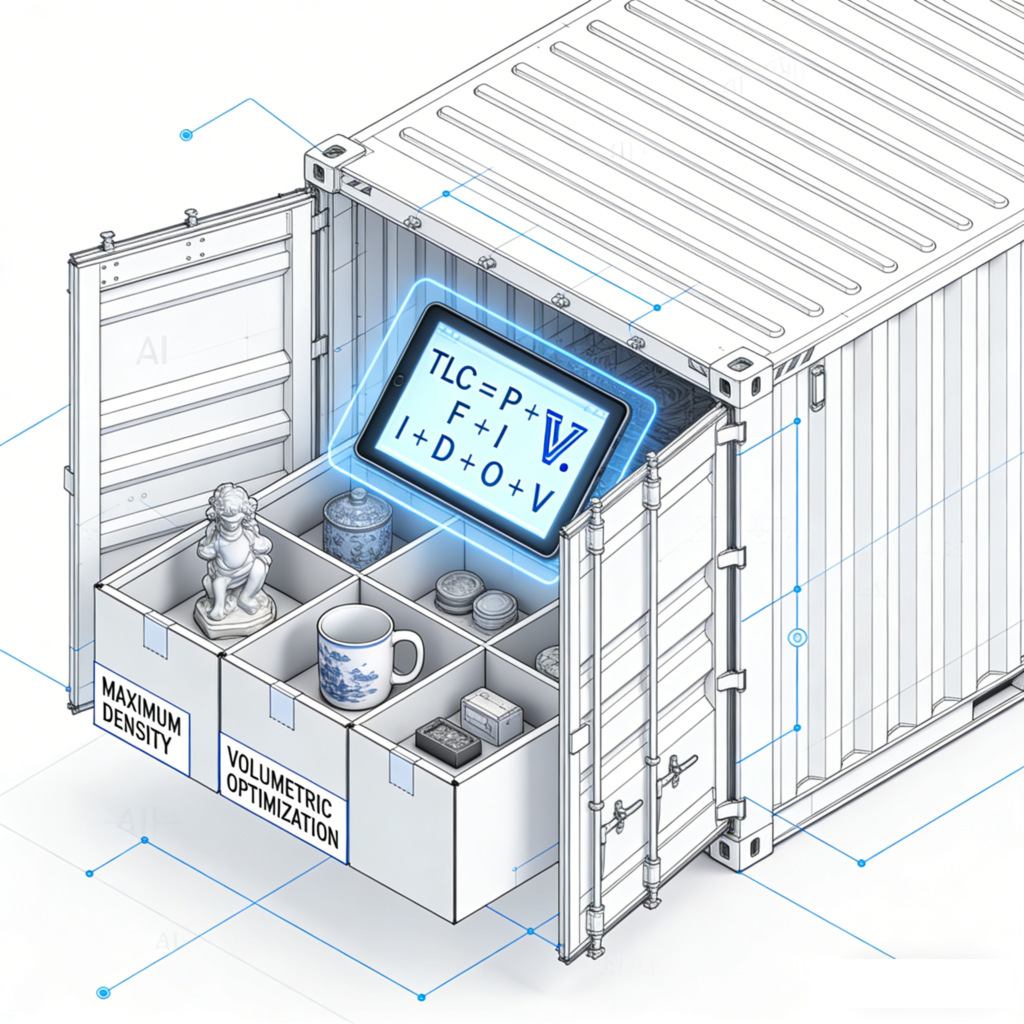
The 2025 TLC formula must expand beyond simple arithmetic ($Product + Freight = Total$). Our technical model is:
$TLC = \sum (P_{unit} \times Q) + F_{inland} + F_{int} + I + D + O + \mathbf{V}$
Where:
- $P_{unit}$: Unit price.
- $Q$: Total quantity.
- $F_{inland}$: Inland transportation.
- $F_{int}$: International freight.
- $I$: Cargo insurance.
- $D$: Duties and Taxes.
- $O$: Other overheads (like souvenir quality control and testing).
- V: New economic and currency variables (including the cost of hedging, the impact of local currency settlements, and any material-cost pass-throughs from the factory).
An experienced importer who fails to include V is flying blind. A strategic landed cost and profit analysis provides you with a definitive financial framework for decision-making.
Re-Evaluating Global Sourcing: The 2025-2026 Map
Competitors’ generic advice to “diversify sourcing” is not strategy. In 2025, diversification must be based on a data-driven understanding of how local currencies are moving.
- Chaozhou Ceramics vs. Turkish Ceramics: Turkey has been a significant player in the high-volume ceramic souvenir market. However, in 2025, the hyper-volatility and inflation in Turkey have made contract predictability almost impossible. In contrast, while Chaozhou, China has slightly higher unit costs, its currency stability is a core financial asset for a large-scale importer.
- A Viet-Nam Sourcing Pivot: Competitor analysis shows that Vietnam is a rising star in general sourcing. For the souvenir market, specifically, a skilled Vietnamese-based resin souvenir manufacturer may offer a profound, data-driven TLC advantage. A temporary dip in the VND against the RMB can create a powerful “currency arbitrage” opportunity for an importer who understands this nuance.
- FSC-Certified Wooden Souvenirs: Traditional guiding principles overlook niche sectors. Environmental and social governance (ESG) compliance, such as using FSC-certified wooden souvenir China resources, is a non-monetary asset that can hedge your brand from reputation risk, a type of non-financial volatility.
Conclusion: Turning Economic Headwinds into Strategic Tailwinds
In 2025 and 2026, the global souvenir market will be a story of two different types of importers. Passive sourcing is dead. Passive importers will see their margins eroded by currency volatility and hidden financial costs, becoming uncompetitive.
Proactive importers, however, will recognize that de-dollarization and multi-polar volatility are not just risks; they are opportunities. By transforming economic risk from an abstract concept into a quantified data point within your Total Landed Cost, you can build a more resilient and profitable global souvenir supply chain.
Compliance is your foundation; technical optimization is your profit center. Passive importing is a memory. Strategic sourcing is your future. Turn economic headwinds into tailwinds.
Are your profit margins being eroded by unquantified macroeconomic risks? Passive calculating is a major trap. Contact Craftmgf.com today for a comprehensive, data-driven Landed Cost Audit. We don’t just quote a unit price; we engineer a profitable and compliant manufacturing partnership tailored for the economic realities of 2025/2026.

- Resin vs Metal vs PVC Fridge Magnets: Which Material Wins for B2B Souvenir Buyers (2026 Guide) - September 2, 2026
- Finding the Best Resin Fridge Magnet Supplier for Your Souvenir Shop: A Detailed 2026 Buyer’s Guide - August 26, 2026
- Resin Fridge Magnets in Bulk: A 2026 Buyer’s Guide to MOQ, Tooling, Lead Time, and Landed Cost - August 19, 2026