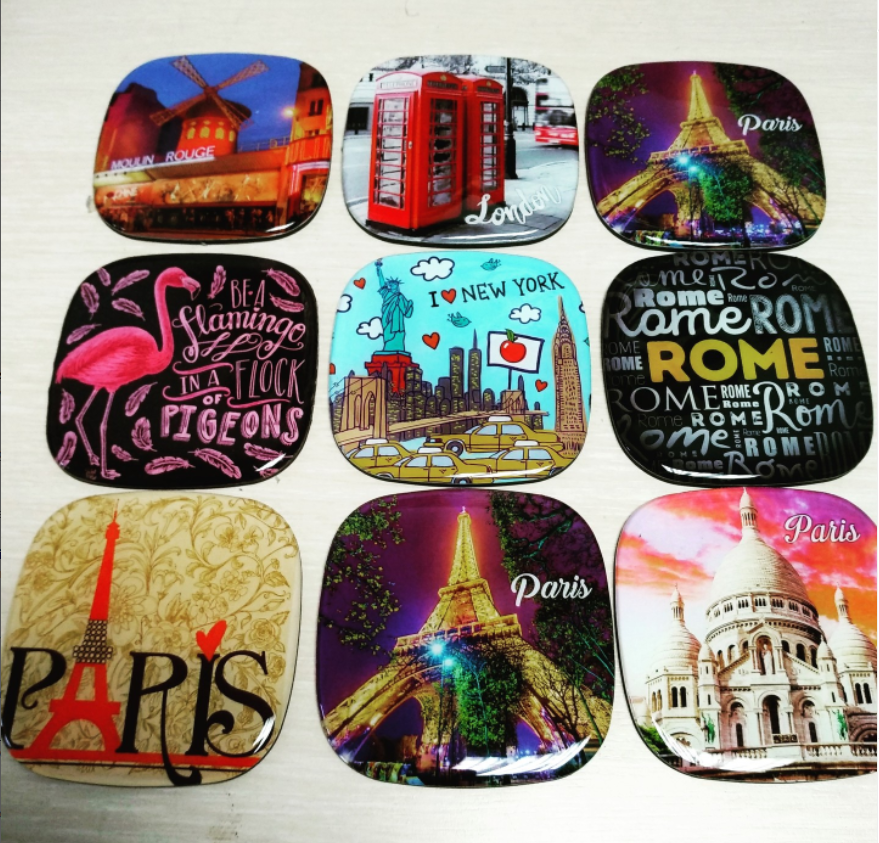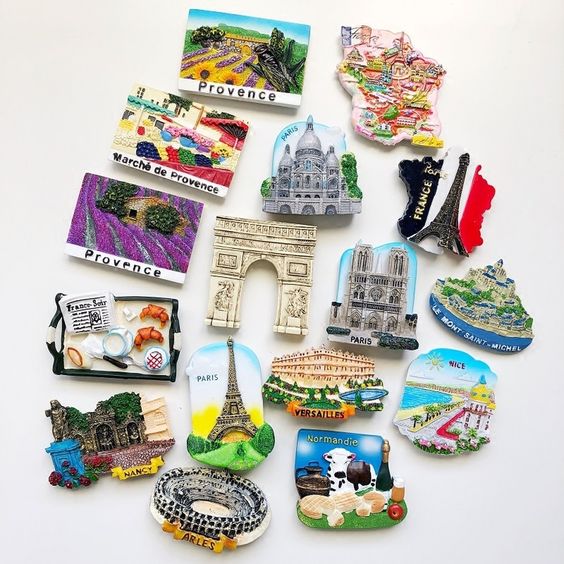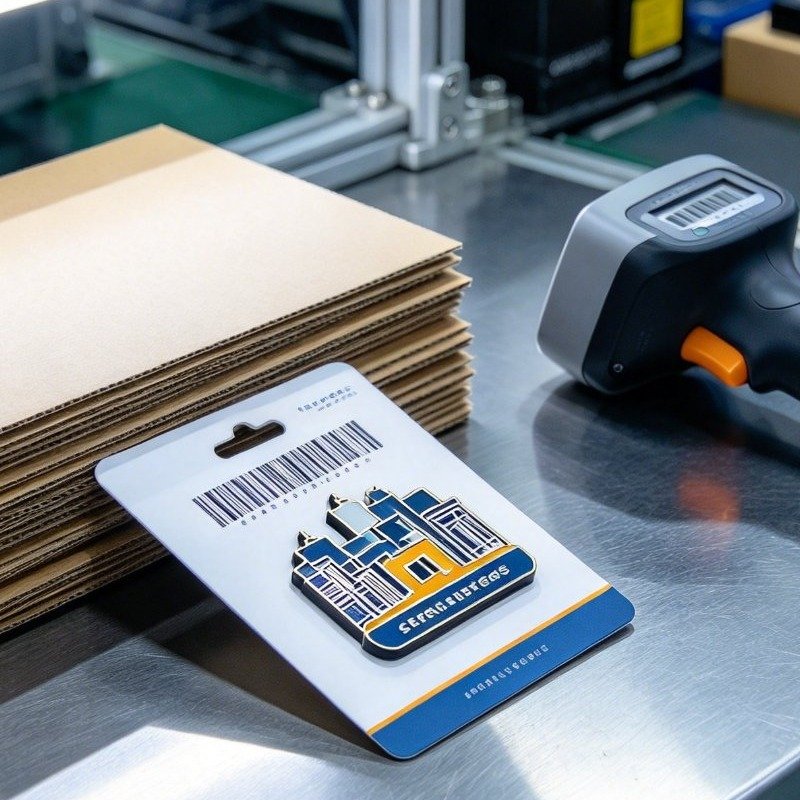
Custom fridge magnet packaging is the part of a souvenir program that buyers plan last and regret first. You spend weeks on artwork, material, backing, and compliance — then the magnets arrive in a plain poly bag with no barcode, and the museum’s receiving team cannot check them into inventory. The unit sits in a back room while you reprint cards, renegotiate, and air-freight. If you are buying resin magnets for a museum store, a national park, an airport duty-free counter, or a distributor feeding retail accounts, packaging is not decoration. It is the difference between a product that can be scanned, shelved, and reordered, and one that stalls at the loading dock. This guide covers the retail ready packaging for magnets that actually gets stocked: the six formats worth quoting, the fridge magnet barcode requirements most factories never brief you on, private label magnet packaging, and the packaging EPR rules that can hold cartons at Customs. Every format, every number, and how to spec it in one conversation.
Why Packaging Decides Whether Your Magnet Ever Reaches a Shelf

Most buyers treat packaging as a protective wrapper. Your retail buyer treats it as the product’s interface with their whole operation. Three things happen at that interface, and packaging either does them or does not.
The first is scanning. The moment your magnet enters a museum store, a park visitor center, or an airport concession, it becomes a SKU in someone’s point-of-sale system. Without a scannable barcode on the unit pack, staff have to key in the price manually, shrink is unmeasurable, and reorder triggers never fire. That is the honest reason retail buyers will not take a barcoded-less magnet no matter how good the resin is. The second is shelf real estate. A pegboard hook, a counter tray, and a glass display case demand completely different pack geometry, and the format you choose decides which of the three your product can occupy. The third is the margin story. The same magnet sold loose versus sold on a printed backing card with the destination name, the collection name, and a short provenance line reads at a different price point, because the pack is doing part of the selling that a staff member would otherwise have to do.
So what is retail ready packaging, in plain terms? It is a unit that arrives already able to be received, scanned, merchandised, and sold without your buyer touching it again. For a souvenir program, packaging is also a cost line with real leverage. It is quoted per program rather than per piece in isolation, because the printed board, the die, and the label setup are one-time costs, exactly like the magnet mold — and like the mold, they are there whether you order 1,200 pieces or 12,000. Ask for the packaging breakout in writing, the same way our guide to bulk ordering says to ask for the tooling and landed-cost breakout. Any factory that quotes a single blended number is hiding where the money goes.
The Six Retail-Ready Packaging Formats You Will Actually Choose Between
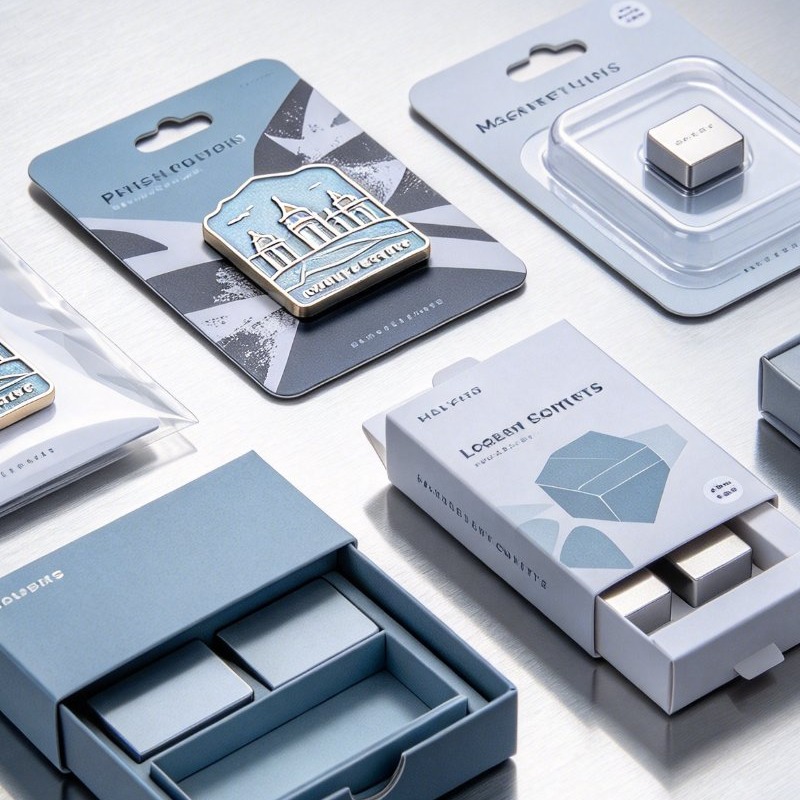
Most souvenir magnet packaging options on the market are variations on six formats. Choose by where the product will live, not by which sample looks nicest in a catalog.
1. Poly Bag with Header Card
The lowest-cost format that is still retail-legal. A clear bag holds the magnet, a printed header card carries the branding, the barcode, and often a hang hole for pegboard. It is light, which matters for freight, and the card is a single print run rather than a die-cut box. The trade-off is protection: a bag offers almost none, so the magnet must already be robust. For a thin UV-printed souvenir at a low price point in a pegboard-driven park store, this is often the right call. For a heavyweight 3D piece, it looks thin.
2. Printed Backing Card (Barcode-Ready)
A rigid printed card behind the magnet, usually with a hang hole and a sealed clear film or a crimped edge. This is the workhorse format for museum and park retail because it solves the two hard problems at once: it gives you a flat, stable, matte surface for a compliant barcode and a defined area for provenance text, and it protects the artwork face from contact damage in a bin. If your buyer asks for a hang tag rather than a bagged unit, this is usually what they mean. The classic hang tag vs blister card decision usually resolves here: the card is cheaper, prints beautifully, and recycles as paper, which increasingly decides the argument.
3. Blister / Clamshell
A formed plastic shell over a printed card, or a sealed two-piece clamshell. Best-in-class protection and a strong premium signal on a glass counter. It is also the format most exposed to sustainability pressure and to packaging EPR fee structures, which eco-modulate against hard-to-recycle plastics. Ask about the polymer before you commit, and get the recyclability question answered in writing — see the sustainability section below.
4. Printed Folding Carton (Color Box)
The premium retail format: a small printed box with a barcode on the base, product facts on the back, and the destination imagery on the front. It is what a duty-free buyer tends to choose, because a box photographs well, stacks flat, ships flat as a knock-down blank, and protects a fragile piece. It also carries the most surface area for compliance text and for your buyer’s own price sticker.
5. Gift Box or Multi-Magnet Set
A boxed set of three to six themed magnets — a city skyline, a park’s wildlife series, a museum’s collection. This is the highest-margin packaging format in the category, because the set price is not a multiple of the unit price, and it is the format most correlated with seasonal gifting. It also multiplies your barcode requirement: each set needs its own GTIN, distinct from the individual units, or the retailer’s inventory system will treat a set as a loose piece.
6. Display Unit / Counter Tray
A printed counter tray, spinner, or shelf-ready tray that ships loaded and goes straight onto the counter. This is the format that wins a distributor account, because it removes labor on their side. It also changes your freight math entirely: a loaded display unit is volumetric, not dense, and cube becomes the constraint rather than weight. Plan it with the same discipline as container loading, and check our material and freight comparison for how pack format and material weight interact on a container.
The Fridge Magnet Barcode Requirements Nobody Briefs You On

This is where most first shipments get rejected, and it has nothing to do with the magnet. The barcode is a measuring instrument, not a graphic. Shrink it to fit your card and it stops being readable at the register.
Which symbology: UPC-A, EAN-13, or EAN-8?
UPC-A is the North American standard for consumer units; EAN-13 is standard in the UK, the EU, Australia and most other markets. They are part of the same GS1 system, and US retailers can scan EAN-13, so a single EAN-13 symbol is a defensible choice for a program that sells into both. EAN-8 exists for packages with almost no printable area; a magnet backing card is usually not that small, so treat EAN-8 as a fallback rather than a default. If a buyer specifically demands UPC-A on a US retail account, that is a print decision, not a new product.
GS1 sizing, magnification, and the quiet zone rule
Every dimension in a barcode spec is expressed as a multiple of the X-dimension — the width of the narrowest bar. At nominal size, an EAN-13 or UPC-A symbol runs an X-dimension of about 0.33 mm, stands roughly 23–26 mm tall, and occupies around 37 mm of width once both quiet zones are counted. GS1 permits magnification from 80% to 200%. The 80% floor is a technical limit for tightly controlled printing, not a target. In practice, most high-volume retail brands print at 100–120% because the rescan rate at the register drops noticeably when the symbol is not at the edge of its tolerance.
The quiet zone is the part buyers break most often. It is the blank margin either side of the symbol that lets a scanner find where the code starts and stops. UPC-A needs at least 9 times the X-dimension on each side; EAN-13 needs roughly 11 times on the left and 7 on the right. In practical terms, budget about 3–4 mm of clear space left and right and 2 mm top and bottom, and never let card artwork, a logo, a printed border, or a laminating edge intrude into it. A barcode that looks fine but has its quiet zone trimmed is the single most common cause of scan failure, and it will be spotted at someone else’s distribution center, not yours.
Who owns the GTIN — and why it should be you, not the factory
A GTIN is a licensed number tied to the brand owner, and in retail it is the identity of your product, not your factory’s. If the factory assigns the number, you do not control your own SKU, you cannot reuse it across suppliers, and a retailer’s system will attribute the item to whoever holds the licence. Register the GTIN yourself through GS1, then send the exact number and symbology to the factory as part of the print spec. This is also the answer to how to barcode a souvenir magnet for retail: you own the number, the factory prints it to GS1 tolerance, and you verify a sample with a real scanner before the bulk label run.
Print quality, matte vs glossy, and the 300 DPI floor
Barcodes must be black on white at full contrast — no grey, no gradient, no colour on colour. Glossy laminate is a genuine risk, because specular reflection can blind a laser scanner; a matte or uncoated print area behind the symbol is the safer choice, and it is easy to specify on a matte-laminated backing card. On resolution, 300 DPI is the practical floor for a small retail symbol; lower-resolution printing softens the bar edges, and soft edges are what make a technically compliant code fail in the field. Before the bulk run, ask for a printed sample at final size and scan it with a phone camera, a handheld scanner, and a fixed scanner if the retailer uses one.
ITF-14 for the export carton
The outer carton needs its own symbol. ITF-14 is deliberately coarser than a retail code because it is printed on fibreboard: a nominal X-dimension around 1.0 mm, a minimum bar height near 32 mm, and a quiet zone of 10 times the X-dimension on each side, with the bearer bar printed on corrugated stock. This is the layer that lets a distribution center receive your pallet without opening it. Get it right and your carton is a trade item; get it wrong and it is a box somebody has to count by hand.
Retail-Ready Packaging Comparison: Which Format Fits Which Channel
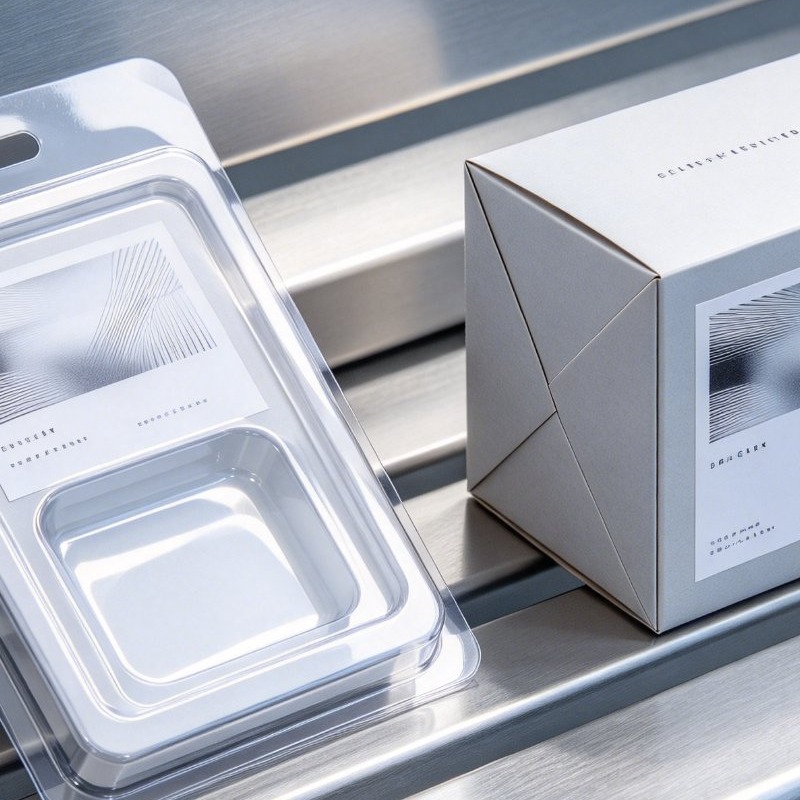
The table below puts the six formats side by side on the dimensions that decide a program — protection, barcode fit, shelf mechanism, recyclability, and e-commerce readiness. Packaging cost is quoted per program, so use the relative column to plan, then get the exact number in your quote.
| Format | Protection | Barcode surface | Shelf mechanism | Recyclability | Best channel fit |
|---|---|---|---|---|---|
| Poly bag + header card | Low | Good — card is flat and matte | Pegboard hang hole | Mixed (film + paper) | Park and visitor-center pegboard, low price point |
| Printed backing card | Medium | Excellent — the reference standard | Pegboard or bin | Good (paper-dominant) | Museum stores, park retail, bin merchandising |
| Blister / clamshell | High | Good — on the printed card insert | Pegboard or counter | Poor — EPR fee exposure | Premium counter placement, fragile 3D pieces |
| Printed folding carton | High | Good — base panel is ideal | Counter or shelf | Good — mono-material board | Duty-free and airport gift retail |
| Gift box / set | High | Required — one GTIN per set | Counter or displayed | Good with board-based construction | Seasonal gifting, tourism boards, high-margin sets |
| Display unit / tray | High (in situ) | Required on unit pack inside | Self-contained counter unit | Mixed — depends on tray material | Distributors, multi-location retail chains |
The pattern worth noticing: protection and recyclability trade against each other, and the barcode-friendly formats are the paper-based ones. That is why the printed backing card has quietly become the default for souvenir retail. It is cheap to print, it gives you a flat matte surface for a compliant symbol, it carries provenance copy, and it lands on the right side of packaging waste regulation. If you are unsure where to start and your buyer has not specified, a printed backing card is the format least likely to be sent back.
Private Label: Printing Your Brand on the Pack, Not Just the Magnet
Private label magnet packaging is where a distributor turns a generic souvenir into a house product. The magnet is yours or ours; the pack carries your identity, your collection name, your destination copy, and your barcode. This is standard under OEM and ODM, and it is worth planning deliberately because the pack is where the perceived value sits.
Three practical notes. First, send the pack artwork and the magnet artwork together. The card, the box, and the magnet face share a palette, and if they are briefed separately you get a card that fights the product. The same print-readiness discipline applies to pack copy as to the magnet — the file checklist in our artwork preparation guide covers formats, bleed, CMYK, and font outlining, and it applies to a backing card exactly as it does to a magnet face. Second, decide print method against run size. Pack board is usually litho or digital; at 1,200 pieces you are planning a short print run, so ask what the card print setup does to your first-order economics and how it amortises on a 5,000 or 20,000 piece reorder. Third, never print a fixed retail price or a currency symbol on the pack unless a specific account has asked for it in writing. A price on the card destroys the item’s usability for any other account, and most museum and park buyers want to price-label in their own system.
E-Commerce Prep: Marketplace Rules Are Stricter Than Museum Shelf Rules
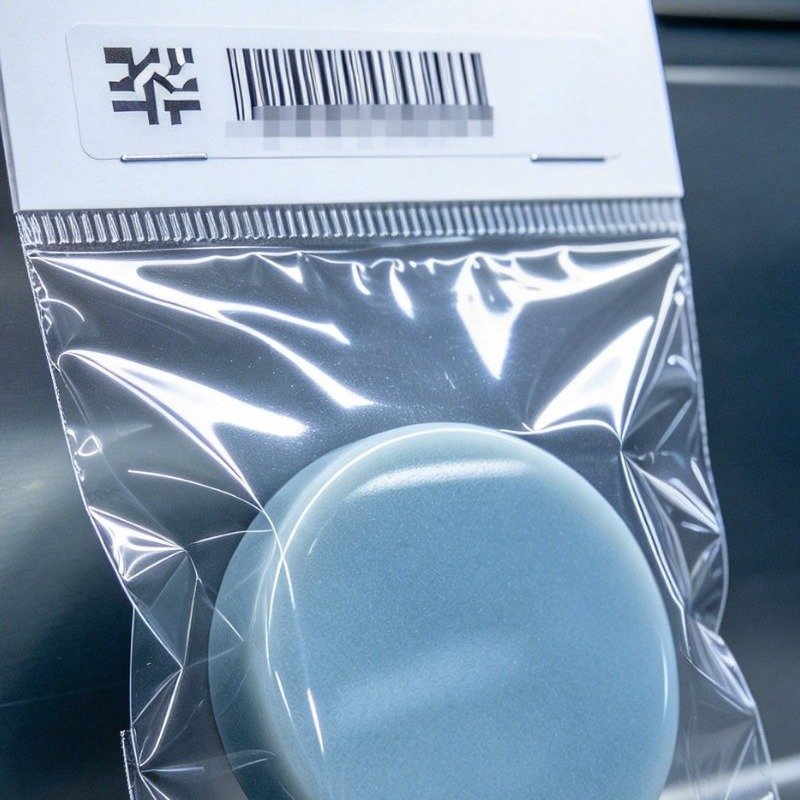
If any of your units go to a marketplace or a web store, the pack has a second set of rules layered on top. This is the part distributors underestimate, because a pack that is perfect for a museum bin can still fail an inbound check.
The recurring requirements are consistent: the unit needs its GTIN registered and submitted to the marketplace, the pack needs a scannable symbol in the condition it will actually arrive in (not flat in a catalog), poly bags need a suffocation-warning statement if they are large enough to be a hazard, and the unit must be packed so it survives being handled alone rather than inside a case. Every one of the factories’ PDF declarations in the world will not compensate for a barcode that has been shrunk onto a curved surface or a bag that has been folded across the symbol.
When the same SKU ships to both a museum and a marketplace, the efficient answer is one pack that satisfies the stricter of the two. In practice that means a printed backing card inside a case, a compliant symbol on a flat panel, a GTIN you control, and a carton marked with an ITF-14 and a lot number. Our own output ships in EPE foam insert trays inside lot-numbered cartons, tested to AQL 2.5 and with 100% pull-force verification against a 450g floor, so the physical protection question is answered inside the pack. The label layer is what the pack has to add.
Sustainability and Packaging EPR: What Actually Blocks a Shipment
This is the newest and least understood constraint, and as of August 2026 it is live. Packaging regulation in the EU is no longer guidance a buyer can postpone; it is an entry condition, and it sits on a different register from product compliance. Passing your magnet’s chemical and magnet-physics tests says nothing about whether your packaging can legally be placed on the market.
Heavy-metal limits on every packaging component
Under the EU packaging regulation, the combined concentration of lead, cadmium, mercury, and hexavalent chromium across packaging must stay at or below 100 mg/kg — and it is a sum, not four separate allowances. A part can pass individually and still fail the total. Critically, the scope is every component, not just the box: the folding carton, the backing card, the printed ink, the adhesive, the clear film, the foam insert, and any metal hardware are all in scope. In practice the ink is the usual culprit, because a different colour formulation is a different ink and may need its own test. Reports must come from an accredited lab, the factory’s own sheet is not accepted by market surveillance, and the paperwork has to be retainable for years because it can be demanded at inspection.
Germany LUCID, France UIN, and the Triman logo
Producers of packaged goods sold into Germany must register their packaging in the LUCID register before first placing it on the market, which yields a 13-digit German registration number. France works through its own producer responsibility scheme and issues a unique identification number, and French law additionally requires the Triman sorting logo with disposal instructions on consumer packaging. The Triman requirement is a print-file requirement, which means it belongs in your artwork brief — it is not something a factory can add later without a reprint.
The per-country registration trap
The misconception that costs the most money is believing one EU registration covers the bloc. It does not. Registration is per member state, there is no interoperable number, and a non-EU seller must typically appoint an authorised representative in each country where it sells. Registration timelines differ sharply by country and are measured in weeks, not days. Marketplaces now verify registration at listing level and suppress offers that lack it, which means the penalty is not a fine you can argue later — it is your listing going dark.
| Market | Registration route | Number format | Mandatory pack marking | Note for a non-EU seller |
|---|---|---|---|---|
| Germany | Central packaging register, LUCID | 13-digit number beginning with the country code | No single mandatory logo; material identification recommended | Authorised representative required |
| France | Approved producer responsibility scheme | Unique identification number | Triman logo plus sorting instructions | Print-file requirement — brief it before the card goes to press |
| Spain | National scheme | Number beginning with the country code | Environmental label and material identification | Authorised representative required |
| Italy | National consortium | Number beginning with the country code | No specific marking currently in force | Authorised representative required |
| UK | National packaging scheme | Scheme-issued producer reference | No centrally mandated logo | Packaging tonnage thresholds apply rather than a first-unit rule |
The practical takeaway for a souvenir program: decide the markets first, register before you print, and bake the required marking into the packaging artwork. If your factories’ pack files are already final when you discover a marking requirement, you are paying for a reprint and possibly a new die.
How Packaging Changes Your Landed Cost and Freight Cube
Packaging moves your landed cost in three ways, and only one of them is the packaging price.
The first is the packaging line itself: the printed board, the die, the film, the label, and the labor to pack out. Because print and die setup are one-time, packaging behaves like tooling — it is amortised across the run, which is why a 5,000 or 20,000 piece reorder improves the per-piece figure without any change to the magnet. The second is volume. A bagged magnet and a boxed magnet with the same weight occupy very different cube, and on a volumetric freight basis cube is what you pay for. A display unit loaded with product can be the least dense thing in your shipment. The third is damage. A pack that does not protect the artwork face creates returns, and returns cost more than packaging ever does. Our own approach pairs EPE foam insert trays with lot-numbered cartons so a weak unit is traceable back to its resin batch, and the same traceability logic applies to a pack: if a reprint or a label defect reaches a shelf, you want to know which run it came from.
Ask for the packaging line item and the packed cube in the same quote. Priced factory-direct with no trading-company markup, those two numbers are what tell you whether a premium pack is worth its shelf gain or just its freight bill.
Matching the Pack to Your Buyer Persona
Different buyer types will reject different things, and the pack is the fastest way to look like you understand their channel.
Museum stores care about provenance and price flexibility. They tend to want a printed backing card with the collection or exhibition name, no printed price, and a barcode on a flat matte panel so it scans in their POS. National parks and scenic-area retail run pegboard and dense bin merchandising on tight margins, so they lean toward header cards and backing cards, and they care about hang-hole consistency across a whole series so the display looks tidy. Airport duty-free and gift retail buy on presentation and travel-proof pack integrity; a folding carton or a boxed set is the natural fit, and the pack must survive being handled repeatedly by strangers. City tourism boards buy through public procurement, where documentation is assumed to exist — pack copy, barcodes, and material declarations should be ready as documents, not as conversation. Distributors are the ones who will ask for a display unit, a GTIN you control, and a pack that survives a warehouse.
If you are planning a range, decide the pack before you decide the price list. It is much easier to match a price point to a pack than to retrofit a pack to a price point — and it is far cheaper than discovering that your chosen format cannot carry a compliant barcode.
Common Packaging Mistakes B2B Buyers Make
- Treating the barcode as an afterthought. It is the reason a retail buyer can stock you at all. Spec the symbology and the GTIN before the pack artwork is final.
- Letting the factory own the GTIN. You lose control of your own SKU and cannot move the product to another supplier without reprinting.
- Shrinking the symbol to fit the card. Below the GS1 magnification floor the code still looks fine and still fails at the register.
- Printing into the quiet zone. A border, a logo, or a laminate edge inside the margin is the most common cause of scan failure.
- Choosing a glossy panel for the barcode. Reflection defeats laser scanners. Matte where the symbol sits.
- Skipping the pack marking requirement. A mandatory sorting logo discovered after the card is printed means a reprint and a new die.
- Assuming one EU registration covers the EU. Registration is per country, and marketplaces verify it at listing level.
- Printing a fixed retail price on the pack. It locks the item to one account and most buyers will not accept it.
- Ignoring cube. A beautiful display unit can cost more to ship than the magnets inside it.
Frequently Asked Questions
Does my fridge magnet need a UPC barcode?
If you are selling into physical retail or a marketplace, yes in practice. A magnet without a scannable symbol cannot be received into a point-of-sale system, so most museum stores, park retailers, and distributors will not stock it regardless of quality. For adult decorative souvenirs sold in the US, UPC-A is the conventional consumer-unit symbol; EAN-13 covers the UK, EU, and most other markets and is scannable by US retailers. Register the GTIN yourself through GS1 and pass the exact number and symbology to the factory as a print instruction.
What packaging do souvenir magnets need for retail?
A unit pack that can be received, scanned, merchandised, and sold without the buyer reprocessing it. In practice that means a printed backing card or a folding carton carrying a compliant barcode on a flat matte panel, a hang hole if the channel is pegboard, provenance copy that justifies the price point, and transit protection strong enough to arrive undamaged. Our own output ships in EPE foam insert trays inside lot-numbered cartons as standard, which handles the protection layer; the pack you add handles the retail layer.
Can a factory print my logo on magnet packaging?
Yes — a factory can print your logo on magnet packaging as standard private label work under OEM and ODM. Send the pack artwork and the magnet artwork together so the palette and typography agree, and follow file discipline for the card exactly as you would for the magnet face: outlined fonts, correct bleed, CMYK, print-ready resolution. Note that pack board is a separate print run from the magnet, so it carries its own setup cost, which is why packaging is quoted per program and amortises better at 5,000 and 20,000 pieces than on a 1,200 piece first order.
What size should a retail barcode be on a magnet backing card?
Work to GS1 magnification rather than a single measurement. At nominal size an EAN-13 or UPC-A symbol has an X-dimension of roughly 0.33 mm and occupies about 37 mm of width once quiet zones are included, at a bar height of roughly 23–26 mm. GS1 permits 80% to 200% magnification, but 100–120% is the range that behaves reliably at a busy register. Keep about 3–4 mm of clear space on each side, 2 mm top and bottom, and print black on white at 300 DPI or better.
Do museum stores require barcodes on merchandise?
In practice, yes. A museum store’s point-of-sale system is an inventory system first, and an item without a scannable symbol has to be keyed in by hand, which most store managers will simply decline rather than absorb. Even a buyer willing to accept an unbarcoded sample will usually require a GTIN before the bulk order is booked into inventory, because that number is what ties the physical product to their stock record and their reorder report. Treat the barcode as part of the museum retail spec rather than an optional extra, and supply the GTIN yourself so the identity stays with your product instead of your supplier’s.
Is blister packaging recyclable?
Usually not easily. A formed plastic shell bonded to a printed card is a multi-material pack, which is exactly the profile that eco-modulated packaging fees penalise, and that consumers cannot separate for recycling. That is why blister has lost ground to paper-dominant formats in museum and park retail. If a premium counter presentation is essential, ask about the polymer and keep the printed card separable so the paper fraction can be recovered.
Do I need EPR registration for magnet packaging in Germany?
Yes, if you are the producer placing packaged magnets on the German market. German rules require registration in the national packaging register before first placing packaging on the market, which issues a 13-digit number, and non-EU sellers generally need an authorised representative. Registration is per member state rather than EU-wide, and marketplaces now verify it at listing level. French packaging also carries its own registration number plus a mandatory sorting logo on the pack.
What is the Triman logo requirement?
The Triman is the French sorting and disposal marking required on consumer packaging sold in France, and it is normally accompanied by sorting instructions. Because it is printed on the pack, it is a print-file requirement rather than a sticker: it has to be in the artwork before the card or box goes to press. Add it to your artwork brief at the same stage you specify the barcode, or you will pay for a reprint.
Request a Quote
Packaging is quoted per program because the board, the die, and the label setup behave like tooling — one-time costs amortised across the run. So the useful quote lists them: the format, the printed board or box, the barcode and GTIN you supply, any required market marking, the carton and ITF-14 specification, the packed cube, the mold charge, the per-piece cost, and the lead time, in plain numbers. Look for factory-direct pricing with no trading-company markup, a 1,200-piece minimum per design so you can launch a range without overcommitting, sampling in 7–21 days, bulk in 45–60 days from sample approval, tiered pricing at 5,000 / 20,000 / 50,000 pieces, AQL 2.5 inspection, and a magnet that holds a 450g pull force on 100% of output.
If you are planning a museum, park, airport, or city tourism magnet line and want a quote that states the packaging format and its numbers alongside the magnet spec, send us your artwork and your target markets. We quote within 24 hours, and we will tell you straight which pack format and which barcodes your channel actually requires — so your first sample is a confirmation, not a reprint.

- Souvenir Magnet Program Planning: What Actually Sells for Museums, Parks & Tourism Boards - October 20, 2026
- Custom Fridge Magnet Sampling and Proofing: The B2B Guide to Approving a Sample (2026) - October 15, 2026
- Custom Mold Ownership & Design IP Protection for Souvenir Magnets: A B2B Buyer’s Guide (2026) - October 9, 2026